
A history of Knole Estate
by Dr Elise Percifull
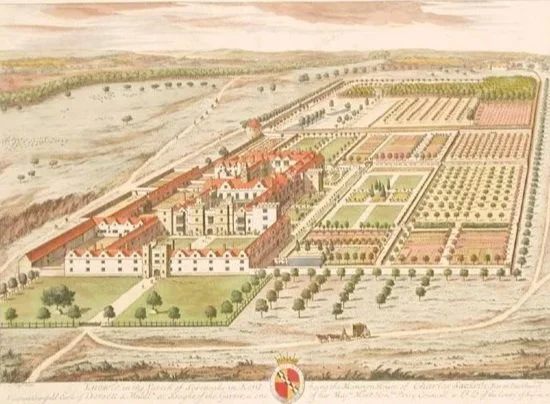
Knole from Kip and Kynff’s Britannia Illustrata (1709)
The Knole Estate comprises Knole Park and a range of agricultural land, residential and commercial property in and around Sevenoaks, as well as further afield in Norfolk, Berkshire and Staffordshire. The Sackville Family gifted Knole House to the National Trust in 1946 and continue to reside in Knole House. Knole Park has a long history and is one of the last remaining medieval deer parks in Britain.
Early history of the park
The first known mention of Knole comes in 1281 and is included in papers held at Lambeth Palace, although a manor is not recorded until 1364.
In the 15th century Thomas Langley, Bishop of Durham owned Knole and he is known to have enlarged the property. By the 1450s the Manor of Knole was owned by Sir William Fiennes, Lord Saye and Sele and consisted of several hundred acres of land. The Manor was bought from Sir William by Thomas Bourchier, Archbishop of Canterbury in 1456 for the sum of £266 It is to Bourchier that the origins of the great house, park and gardens at Knole can be attributed.
In the same year that he purchased Knole (1456), Bourchier was given permission to enclose land to form a park on his estate. This original deer park seems to have covered roughly one third of the current park area, and was concentrated in the northern, central part of what is now the registered landscape. What the park created by Bourchier was like can only be speculated at. The word park is thought to derive from the Old English word pearroc, which simply meant paddock or enclosed field. However, during the medieval period the word became more specifically used for a private enclosure where deer were kept. Such medieval parks were commonly enclosed tracts of semi-wooded countryside, often taken in from the waste ground on the edge of the manor and thus they differed significantly from the landscape parks of the 18th and later centuries. Bourchier’s park must have reflected this tradition and the presence of hawthorns, hornbeams, maple and ash at Knole reflects the typical woodland cover of the Weald. Although the origins of deer parks are ancient, it was not until the 12th and 13th centuries that England saw significant numbers of such parks. It has been estimated that by 1300 there were probably more than three thousand deer parks in England, although the number declined during the 14th century. Although a park fulfilled a variety of functions, such as grazing for livestock, including pigs, as well as supplying timber and fuel, its primary purpose was to provide venison and to create a location for hunting. The need to maintain a boundary fence and provide a lodge for hunting parties and the park keeper meant that deer parks were expensive to maintain and have thus always been potent symbols of status, generally owned by the aristocracy or great landowners such as the church. The origins of Knole Park are, therefore, similar to other such landscapes throughout the country, for example at Leconfield in Yorkshire or Moccas in Herefordshire.
As Knole was owned by Bourchier, its position between Canterbury and London no doubt contributed to its value and its importance to the Archbishop. That Bourchier went beyond providing a park is clear. Surviving fabric and other records indicate that he started to aggrandise the house, providing improved facilities and accommodation. A lavender garden and orchard were also planted near the House which implies that Knole was used regularly for enjoyment and social entertaining. Thus, like other such places, Knole seems to have been developed in the 15th century to provide both beauty and utility for its owner.
Bourchier’s tenure lasted for 30 years and the Archbishop died at Knole in 1486. On his death the estate was bequeathed to the See of Canterbury and then passed to Bourchiers’ successor as Archbishop, John Morton. Little is known of Morton’s ownership although it is suggested that he enlarged the park sometime before his death in 1500.
Knole remained with the See of Canterbury during the early 16th century and was in regular use by the Archbishops. Under William Warham’s tenure not only were changes made to the House, but Henry VIII is known to have frequently visited Knole to hunt between 1502 and 1514.
Knole remained with the See of Canterbury until the unrest associated with the Dissolution of Monasteries forced Thomas Cranmer to surrender the property to Henry VIII in 1538. How much use Henry made of Knole is uncertain but it has previously been assumed that Henry made substantial improvements to the House and added land to the park. Certainly in 1543 and 1546 the King spent £872 and £80 respectively on his Kent properties, but recent research has questioned whether this was on Knole or Otford or perhaps shared between both. It had been suggested that part of this money was directed at building the new gatehouse and side ranges which now form the western elevation of Knole House, but current thinking is that either Archbishop Morton or Warham were responsible for the building works. Certainly both archbishops are recognised as enthusiastic builders at both Lambeth and Croydon. Henry does, however, appear to have given money to the steward of the Manor, Sir Richard Long ‘for making the King’s garden at Knole’.
Henry VIII was known as a keen huntsman and it is not surprising to see references to the maintenance and development of the park in the historic record. In 1543 accounts record payments made to the keeper for mowing brakes for the deer, while in 1544 around 74 acres of land were emparked to the south-west of the House and gardens. A survey of 1556 later recorded the park as covering 446 acres and holding 50 deer. Henry died in 1547 and from then until the late16th century there were many changes of ownership at Knole. Within this maelstrom one family name is notable for its subsequent influence. In 1570 Thomas Sackville acquired the property from John Dudley and William Lovelace for the sum of £1,000 each. What Sackville’s intentions for Knole were at the time cannot be ascertained, but financial problems and other issues cut his tenure short. Prudence forced Sackville to let Knole in 1574 to John Lennard, a local landowner whose family were to occupy the house for the next 30 years.
Although there is uncertainty over the exact dates, the second half of the 16th century may have seen the building of the Kentish ragstone walls which enclosed the gardens to the south and east of the House, though whether these gardens extended as far as the present enclosure is not known.
It is known that the characteristic mixed use of the park was maintained throughout the 16th and into the 17th centuries. Records show that timber from the park was sold for shipbuilding at Chatham, while coppice wood was used for hop poles and as fuel in the local glass industry. There are also indications that some of the park was ploughed for crops, although the location is unknown.
Knole in the sixteenth century
The making of Knole - Thomas Sackville and the family inheritance
By 1604 Thomas Sackville had rebuilt his family fortunes and was able to buy back the lease of Knole for £4,000. The following year he became the freehold owner of the property and was made the Earl of Dorset. With his status and finances restored Thomas undertook major alterations to the House together with improvements to the park. Tradesmen from the King’s Works were brought to Knole to add contemporary touches of taste and style, such as the works to encase the timber galleries with stone and provide an impression of symmetry to the house.
Thomas Sackville died in 1608 and was succeeded as Earl of Dorset by his son Robert and the following year by his grandson Richard who became the 3rd Earl. Richard’s ownership of Knole may not have produced dramatic changes to the landscape, but his wife Anne’s diaries provide a glimpse of early 17th century life. She records, amongst other things, walking in the wilderness in the gardens and going to the ‘standing’ which is possibly a reference to a viewing area or a site for observing a deer chase. Other records indicate that the gardens contained 4 stew ponds for carp and that around 1611 some 550 acres of land were added to the estate south of the White Hart Inn. What is not clear is whether this land formed part of the wider estate or was included within the park.
Richard Sackville’s tenure of Knole was brief but in that time he ran up substantial debts of more than £60,000. To finance his life style he had sold most of his estates, especially properties in London and had mortgaged Knole together with land at Seal to a London businessman, Henry Smith, and was renting it back at a cost of £100 per year. Knole was inherited by Richard’s younger brother Edward who became the 4th Earl of Dorset. Edward had a distinctly different character to his brother and in a diligent and sober manner set about restoring the fortunes of the estate and buying back the property for the family. A mark of the financial position Edward found himself in is given by estate records which indicate that in 1625 one fifth of the income generated by the park came from the sale of rabbits. At this time the park was also used for cattle grazing and hop growing.
Through his connections to the Crown and via the benefits of high office, Edward was able to pay off his brothers debts and probably extend the estate. However, the Civil War was to disrupt the gradual revival of Knole. Edward’s royalist sympathies led to him join the King’s side in 1642 and Knole became a target of the Parliamentarians. A pre-emptive raid was carried out on Knole in 1642 and the following year it was sequestered by Cromwell and substantial fines levied. These fines were eventually paid by the 4th Earl in 1650 and Knole was returned to the possession of the family.
In 1677 the estate was inherited by Charles Sackville, 6th Earl of Dorset and he was to undertake a series of improvements at Knole. The icehouse to the west of the house may have been built in this period while in the gardens it is thought that under Charles’ guidance a number of grills were inserted into the garden walls to create opportunities for views in and out. It may even be possible that Charles significantly extended the gardens. The creation of the claire-voires is of interest for two main reasons. Firstly, it suggests that the relationship between the park and garden was changing, with a greater desire to link the two elements and increase the influence of the park. Secondly, it implies that allees already existed in the gardens and ran up to the boundary walls, or that allees were being cut or created through the gardens and the alignment extended out into the park.
Later in Charles’ ownership, accounts from 1687 record timber sales from the Wilderness listing oak, ash, beech and cherry as well as coppice stools of ash. Further accounts list payments for mowing the grass in the orchard and Wilderness together with payments for grubbing up pollards and planting fruit trees. Taken as a whole this seems to suggest on-going development and change in the gardens around the House. A decade or so later the Kings Gardener, George London supplied fruit trees to Knole from his Brompton Park nursery.
The results of all these works are clearly shown on a set of engravings of the late 17th and early 18th century by Kip and Knyff, and latterly Badeslade. Although there are minor variations between them, the engravings show a Franco-Dutch style of formal gardens laid out to the south and east of the house. These gardens cover c.24 acres and appear characteristic of the style of later 17th century gardens – and therefore more attributable to the achievements of Charles Sackville. If this extensive garden was enclosed either by the Lennard family (c.1574 – 1604) or others, as has been suggested by other commentators, they would have been on a prodigious scale and would surely have been widely known and recorded.
As it is, the first existing images of any quality come from Kip and Knyff in 1698 (pub 1707–09) (the year in which George London supplied fruit trees to Knole) and Knyff alone, dated 1702-06. The engravings show that to the west the House was approach along a wide gravel drive leading to the gatehouse, this drive passing on through the Green Court with the axis maintained on the eastern side of the house in a long allee that ran all the way to the eastern boundary wall where a gate is depicted. To the north of the house are a series of walled service courts and outbuildings. To the south is a series of small parterres that give way to a broad walk beyond which are several rectangular compartments. The gardens are divided on the eastern side by a high wall which runs from north to south and separates the wilderness from the gardens around the House.

Engraving of Knole by Knyff in the early 18th century (c. 1706)
The engravings provide little information on the character, make up or extend of the wider park or estate land. To the west of the House is a grass area, enclosed from the park by a palisade fence and boundary planting of trees. To the south of this is a small triangular grove which screens much of the gardens from the park. Along the southern side of the garden is a continuous row of trees and a similar feature exists along the northern side of the wilderness. The park to the north is depicted with a loose scatter of trees and enclosed by a more substantial woodland belt. To the north east of the gardens is an eye-catching planting on a small knoll, while just to the south of this there appears to be a farm. A fence linking the south-east corner of the gardens to the farm suggests that some sub-division of the park was practiced in line with deer management in other parks.
Charles Sackville died in 1706 and was succeeded by his son Lionel who was later to be made the 1st Duke of Dorset. Charles’s legacy to the landscape at Knole appears to be immense and the structure of the gardens as they exist today can probably be attributed to him. However, his son was to continue in his father’s footsteps by initiating changes to the Knole landscape soon after inheriting the estate.
In 1709–10 Lionel employed the services of the Westminster gardener Thomas Akres (or Ackers) to redesign, and subsequently to give advice on, the upkeep of the gardens. Akres’ contract for the works is enlightening, providing clear evidence of what he undertook and what previously existed. The contract states that Akres:
The nineteenth century- formality and the passing influence of the picturesque
‘is to lay out in form the little partar before the cloister as is expressed by the letter A in the platform or scheme thereof given by the said Thomas Akres and signed by him and to lay the said partar with Ruf and gravel and plant the same with handsome evergreens of about 4 foot high. To layout the Bowling Green called the Mount in the said draught or scheme for a bowling green and to plant a little wood at each end with flowering shrubs and a hedge round either of elm hornbeam or yew and to take away the wall which supports the Tarris and make it into a slope and to lay all the slopes and bowling green with turf and to make the slopes between the partar and the bowling green and plant with pyramid yews of about 4 feet to cultivate the Kitchen Garden by the stew ponds trench it with dung and lay it out for a kitchen garden. To cultivate and dung all the dwarf trees and borders under the wall in the plantations of dwarfs set out under letter (?) and carefully prune all the dwarf trees and hedges of apples and filbreds. To lay out the little kitchen garden in beds and quarters proper for a kitchen garden to cultivate earth and dung that slip of ground between the walls and the woods within the two hedges and plant two hedges one of fruit the other of yew To lay out the low ground by the wood and to digge a canal forty foot wide and about 4 foot deep to make the pond at the end something regular and handsome and to find all workmanship and materials to dig all gravel turf earth and sand to find all plants at his own expense to mow rowle beat and edge all within grass walks’
The contract states that Akres was paid a total of £396 and the work seems to have been finished by 22 November 1711 when the last payment was made. The work achieved by Akres is clearly depicted in two bird’s eye views of Knole prepared by Thomas Badeslade in 1719. While the general character of the gardens remains similar to that shown by Knyff at the turn of the century a number of changes had occurred. The sweeping away of the mount and the creation of an oval bowling green with arbours to the south of the house is an obvious change, but there are also changes to the orchards near the southern boundary wall. Here the trees are now mostly trained dwarf varieties. A secondary east –west allee has also been cut, extending from the south side of the bowling green through the wilderness. The wilderness itself has undergone significant changes and now contains serpentine walks and radiating allees which are contemporary with changes on other estates at this time, such as Houghton and Chevening.
Akres contract mentions works to the kitchen garden and others have taken this to mean the creation of the walled garden located to the east of the Birdhouse. However, comparisons between the Knyff and Badeslade engravings suggest that the stepped wall dividing the wilderness from the more ornamental courts around the House had been replaced by a straight wall – thus it is possible that the contract reference is to work being carried out within the existing walled gardens, rather than a new kitchen garden further afield. Further doubt is cast on the assumed date of 1711 for the walled garden in the park as estate accounts mention the production of bricks for the kitchen garden walls between 1716 and 1730.
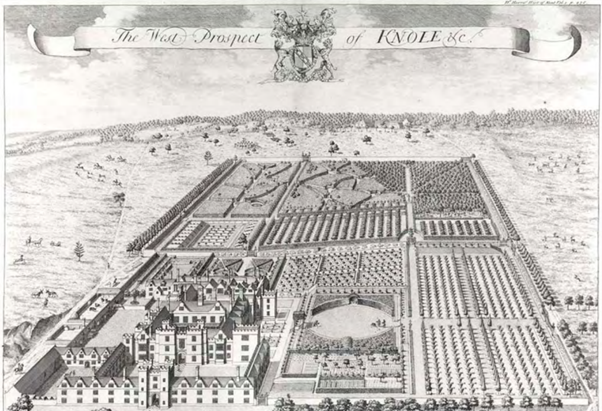
It is often said that Knole did not adopt the parkland landscape ‘improvements’ which were so popular in the 18th and 19th centuries and avoided the self-conscious character of the picturesque. However, it was far from static and contemporary design ideas seem to have been adopted through the 18th century. In Badeslade’s West Prospect the parkland surrounding the gardens is relatively unchanged from that of 20 years earlier. Some ornamental park planting appears to have taken place to the east of the gardens and the row of trees outside the south wall has been pierced to allow views out across the park. However, Badeslade’s second engraving of the view from the south shows dramatic change in the park, although the trees are shown as being relatively mature and in the immediate vicinity of the west front match the character drawn by Knyff. In this view a series of avenues are shown radiating out from the house across the park in contemporary fashion. Duchess Walk is shown with the park pale just beyond the end of the avenue. Similar avenues are shown running towards the main entrance, to what is now the Plymouth Lodge, and a truncated avenue runs to Echo Mount. On the south side of the gardens a double avenue extends across the park from the gates on the main axis of the House.
Estate accounts make it clear that considerable landscape planting was undertaken in the park by the 1st Duke and that other works included at least some picturesque additions. Between 1718 and the 1750s tree planting occurred around the Keepers Lodge, an oak avenue was set out, plantations were created along the Tonbridge road and in 1735 the Chestnut Walk was formed, possibly in association with a grotto. Between 1754 and 1761 the Birdhouse was built as a folly in the park and the associated ruins beside it may also have been landscaped. According to Ward, the planting of the Chestnut Walk was made possible by the Duke’s purchase of 93 acres of land from the Rumshott Manor which were incorporated into the park.
The first great period of landscape improvements at Knole came to an end with the death of the 1st Duke in 1765. The estate and title were inherited by his son Charles whose brief tenure had a draining effect on the estate.
Fortunately for Knole Charles was succeeded by his nephew, John Frederick Sackville as 3rd Duke of Dorset and a return to a more considered management for the park and wider estate followed. After tree felling by his predecessor, John Frederick had the vision and ambition to carry out extensive replanting in the park. In 1792 more land was acquired to extend the park at Locks Bottom and new hothouses were built for the cultivation of pineapples and other fruit. At some stage in the late 18th century a viewpoint was created at Mast Head and cedars planted to ornament the site. The 3rd Duke also added fashionable touches to the House.
No detailed maps from the mid 18th century survive for Knole, but the park is depicted in schematic form on the Andrews, Dury and Herbert Map of Kent dated 1769. It is shown enclosed by a pale and encircled by dense woodland through which are cut a number of rides especially to the south of the house. The House and garden are represented on the plateau with the Duchess Walk extending north of the stables. The kitchen garden and gardener’s house are in place and divided from the Birdhouse by a short section of avenue planting. The Birdhouse and ruins are partly enclosed by planting. What the 1769 map clearly shows is that the park did not extend as far north as it does now.
Engraving of Knole by Badeslade c.1719
The 3rd Duke died in 1799 when his son and heir, George, was still a minor. Apart from a few years in the second decade of the 19th century, Knole was managed until 1825 by John Frederick’s widow, Arabella and her second husband, Lord Whitworth. A further strip of land was added on the eastern side of the park by taking land in from Fawke Common. Around 1813 the estate also planted c.30,000 young trees in the park including beech, sycamore, larch and ash. George Sackville came of age in the second decade of the 19th century but his life was tragically cut short by a riding accident in 1815. His mother Arabella died in 1825 and her will divided the Sackville estates between her daughters Mary and Elizabeth. Knole passed to Mary who had previously married the Earl of Plymouth in 1811. During Mary’s time at Knole the gates and lodges in the north west of the park were added and are today known as the Plymouth Lodge.
In 1825 and 1827 there were further additions to the park. Initially Knole Paddock was brought into the park – although this may historically have been part of an earlier deer park anyway. A more substantial addition was the incorporation of the fields of Blackhall Manor on the northern boundary of the estate. The estate may have purchased Blackhall in the late 18th century and an estate map of May 1827 shows the layout of farms. However, the southern section of the farm was emparked between May 1827 and November the following year. Here the fields seem to have been enclosed by a stone wall and a limited amount of hedgerow removal took place leaving the existing trees to create an instant park landscape (see extract of 1827 map below). By the late 1850s and possibly into the 1860s, new plantations were being established at Fawke, Broadwalk and Shendon. Further minor additions were made in the mid 19th century on the western and south eastern boundaries of the park.
The Earl of Plymouth died in 1833 and in 1839 the Countess, (formerly Mary Sackville) married William, Earl Amherst (1773 - 1857). The landscape additions and park created by Mary and the Earl of Plymouth is best shown on the Sevenoaks Tithe Map (c.1830 - 40). Although not showing the position of individual trees and some other features such as the kitchen garden, the Tithe Map does give a good overview of the character of the park and the spatial distribution of woods, drives and pasture. In fact the landscape shown on the Tithe Map is still close to the park landscape which is seen today. Mary died in 1864 and Knole passed to her sister Elizabeth (1795 - 1870). Elizabeth had married George Sackville-West, 5th Earl of De La Warr in 1833 and, therefore, created the Sackville-West line of the family. She died in 1870 and Knole eventually passed to her third son, Mortimer. Between 1840 and 1871 there were a few subtle changes in the park. Firstly, the estate yard complex of buildings was added to the north of the stable court. Secondly, the valley planting was slightly altered to accommodate a rifle range, resulting in the straight vista we see today. Finally, there were some minor amendments to the drives on the north west side of the house.
Mortimer’s time at Knole is noted as much from the troubles it caused as for any works in the park. During the late 19th century visitors to Knole and other parks had increased. With the arrival of the railway and the proximity of London Knole was soon a popular destination, attracting over 10,000 visitors in 1874. Family tradition has it that Mortimer was increasingly vexed by the number of visitors and shut the doors of Knole to the general public. Further unrest followed in 1884 when the Earl tried to dispute public rights of way through the park. So upset were the local community that two nights of rioting followed during which barriers across the routes were ripped up and the House besieged.
Though Mortimer eventually had to concede to public access in the park the doors to Knole House remained closed until his death in 1888. Mortimer was succeeded by his brother Lionel who became the 2nd Lord Sackville and he eventually took up residence at Knole in 1889. One of the 2nd Lord Sackville’s daughters, Victoria, took on the running of the household at Knole and is credited with much of the updating of the House, including the installation of hot running water and electricity.
Victoria eventually married one of her cousins, Lionel in 1890 and although their marriage was anything but peaceful, they had a daughter, Vita, who was born in 1892. Literary connections at Knole continued in the early 20th century as the House was used as the setting for Virginia Woolf’s Orlando. A copy of the book was later presented to the family in 1928 and remains at the House.
Knole in the nineteenth century
Changes at Knole in the first half of the 20th century were limited. During the First World War substantial areas of the south park were used for military camps, a use that was to be repeated during the Second World War. In 1924 a golf course was laid out in the north park by J. Abercrombie, to which was added a club house designed by the architects Fowler, Abercrombie, Simpson and Croome. As the 20th century progressed, rising taxes and death duties placed a strain on the economies of Knole, like many country houses. As early as 1935 the 4th Lord Sackville had begun discussions with the National Trust over the future of the house. These negotiations continued throughout the war and in 1946 - 47 the house, gardens and a small part of the park were gifted to the Trust.
Since that time the ecological value of the park has been recognised through its designation as a Site of Special Scientific Interest. In 1987 Knole, like many areas of south east England, was devastated by the Great Storm which felled substantial areas of woodland in the park and in the gardens.
Changes in the twentieth century
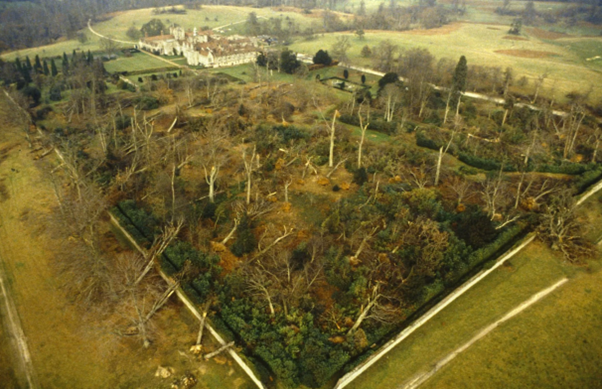
Following the clearance of the storm damage the estate, working in conjunction with Historic England and others, has been instigating a restoration plan for the park planting. Conservation and restoration work in the park are ongoing and include the repair of significant historic structures, improved management of the grass and woodlands, and replacement tree planting in the open park.